
Under the Influence
How MAGA Became Israel First

What has been will be again,
what has been done will be done again;
there is nothing new under the sun.
Ecclesiastes 1:9
In September of 1796, George Washington published his Farewell Address to the nation of the United States, informing of his decision to retire from public life. Voluntarily and peacefully stepping down from office was just one of many precedents set by the first president.
In his address, Washington highlighted three key themes. First, he emphasized the importance of national unity, cautioning against regional divides. Second, he outlined the dangers of partisan factions and the divisions that would arise amongst the public through partisan exploitation. And lastly, drawing from years of watching foreign loyalties poison his own cabinet and fracture the republic he had bled to build, Washington delivered his most urgent warning: that foreign entanglements would not just compromise American diplomacy, but American judgment itself.
Excessive partiality for one foreign nation and excessive dislike of another cause those whom they actuate to see danger only on one side, and serve to veil and even second the arts of influence on the other.
During the American Revolution, the French proved a vital ally against the British. Frenchmen such as Marquis de Lafayette, Comte de Rochambeau, François Joseph Paul de Grasse, among many others, proved consequential to the American victory. However, when revolutionary France declared war on Great Britain in 1793, Washington pushed back on the notion that the United States should support the French out of a sense of national gratitude.
On April 22, 1793, Washington issued his Neutrality Proclamation, declaring the United States a neutral party in the military dispute between Great Britain and France. He believed involvement in a foreign war, and partial allegiance to any nation, could have adverse effects on the economic strength and longevity of the young nation. In accordance with this principle, he pushed for the Jay Treaty, which ultimately normalized trading relations with the British.
Loud and contentious factions formed within his own administration, with Alexander Hamilton a prominent voice for neutrality and Thomas Jefferson a vocal advocate for the French. Critics of the president’s neutrality position accused Washington of having betrayed the Revolutionary cause, but Washington withstood the attacks and stood firm in his pragmatic approach to foreign entanglements. Allowing such favoritism toward another nation would distort domestic politics, compromise sovereignty, and drag the nation into conflicts that didn't serve its interests.
The great rule of conduct for us in regard to foreign nations is, in extending our commercial relations, to have with them as little political connection as possible.
Sage words of advice from the nation's first leader, though words that have fallen on deaf ears. Few nations have wielded more influence over the leadership class of the United States than Israel. And that fact has never been more evident than it is today.
The Israel Lobby
The story of how that influence was built begins with a single man, a foreign agent registration he was determined to escape, and an organization the Department of Justice tried, and failed, to stop.
The modern nation of Israel was officially formed on May 14, 1948 at the end of the British mandate of Palestine. President Truman recognized the country as an independent nation the same day. However, the relationship between the United States and Israel was strategically distant, as the U.S. wanted to avoid alienating Arab Gulf nations in the midst of the newly-started Cold War.
Isaiah L. Kenen played an influential role in advocating for the formation of Israel. He was born in Canada in 1905 into an Orthodox Jewish family with Zionist commitments, rooting him in an ideological framework. In adulthood, Kenen moved to the United States, becoming a practicing lawyer and journalist, as well as an American citizen. By 1943, he was working as Information Director for the Zionist Emergency Council before becoming the Information Director for the Jewish Agency delegation at the United Nations in 1947. There, he lobbied on behalf of the formation of the Jewish state.
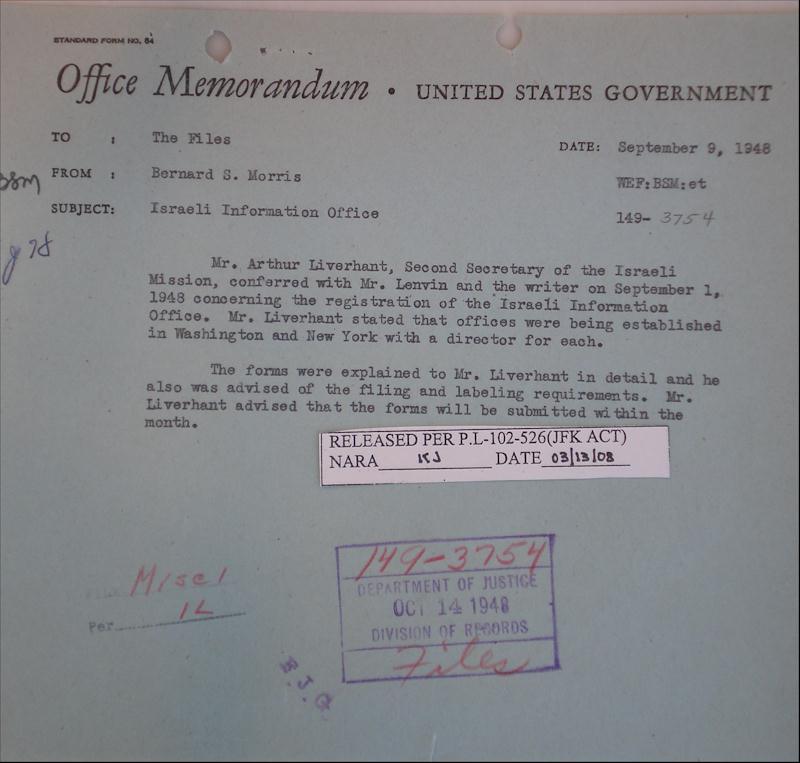
Arthur Liverhant, Second Secretary of the Israeli Mission, established the Israeli Information Office in September of 1948, with offices placed in both Washington D.C. and New York. The Information Office was covered under the Israeli Ministry of Foreign Affairs. Kenen was named as Director of Information for the Israeli government in the New York office on October 16, 1948, prompting him to have to register in the U.S. as a foreign agent, under the Foreign Agents Registration Act of 1938 (FARA). Kenen was officially working on behalf of a foreign entity.
In 1951, after years of lobbying the United States government on behalf of the Israeli government, Kenen resigned his post, announcing on February 13th that he had “severed [his] relations with the Israeli government.” However, what appeared at face value as his relationship with Israel coming to a close was merely a change in lobbying strategy by the Israeli government. In his book, Israel’s Defense Line, Kenen admitted the "Israelis began looking for a lobbyist to promote the necessary legislation.” Kenen stepping down from official service to the Israeli government provided an opportunity to break free from FARA oversight, as he would no longer be viewed as a foreign agent.
Kenen would go on to join the American Zionist Council (AZC), leading their lobbying arm, the American Zionist Committee for Public Affairs (AZCPA), which appealed directly to the United States’ Congress. This was not an available avenue under his former registration, as he was limited to communicating only with State Department ambassadors.
Concerns eventually arose about a former agent of a foreign government leading a lobbyist organization, and questions about the organization’s funding began to raise red flags. By the early 1960’s President John F. Kennedy’s Justice Department began scrutinizing the activities of the AZC more closely. On November 21, 1962, based on evidence the AZC had laundered upwards of $5 million dollars from the Israeli government, the Department of Justice formally ordered the AZC to register under FARA.
On January 2, 1963, Kenen went on to incorporate the American Israel Public Affairs Committee (AIPAC) as a separate entity, becoming the new home of the AZC’s lobbying functions. Though the organization used the same personnel and mission as the AZC, AIPAC would claim it relied exclusively on domestic dollars to fund its advocacy, helping it evade FARA registration. Kenen would go on to lead this organization until his retirement in 1974.
Documents from the Department of Justice, released in 2008, revealed that the nation of Israel had funneled upwards of $5 million dollars into AIPAC via the AZC, to be spent on U.S. propaganda campaigns, leading to the inquiries by the Kennedy administration. AIPAC claims on its site that 100% of its donations are from the United States, which is not necessarily disputed, but is proven to not be historically correct.
By 1997, AIPAC would be ranked by Fortune magazine as the second most powerful lobbyist organization in Washington, D.C. To date, AIPAC is still not registered as a foreign agent under FARA.
Lobbying Activities and Campaign Contributions
AIPAC participates in a number of other lobbying activities. They host an annual policy conference, lobby on specific legislation activities, and partner with the American Israel Education Foundation to provide congressmen and women with “educational trips” every two years to Israel. These claim to “help educate political influencers and potentials about the importance of the U.S.-Israel relationship through firsthand experiences in Israel.” The trips often raise allegations that they violate ethics rules prohibiting lobbying groups from gifting personal travel to congresspersons. AIPAC, among other affiliated groups, has also been instrumental in getting state and federal lawmakers to pursue antisemitism-related legislation and orders.
One of the biggest indicators of AIPAC’s influence is the amount of foreign aid Israel receives from the United States. According to the Council on Foreign Relations, as of 2024, Israel has received over $330 billion since the end of World War II. This makes the nation of Israel the largest recipient of foreign aid of any nation from the United States. The next closest nation is Egypt, who has received around $180 billion.
Between 1971 and 2007, the majority of aid sent to Israel was economic in nature, though the entirety of aid since then has gone towards the military. Unlike other nations that receive military aid, Israel gets a lump sum at the start of every year, and is not required to spend 100% of those funds on U.S. manufactured defense tools and weaponry.
AIPAC has also been embroiled in a number of espionage cases. One of the most notable violations occurred between 1999 and 2004. In 2005, the FBI arrested an analyst at the Department of Defense (now Department of War) for relaying information about “potential attacks on U.S. forces in Iraq,” as well as information related to U.S. policy towards Iran, to two officials at AIPAC. This Top Secret information was then allegedly passed along to members of the Israeli government. The Department of Defense analyst ultimately pleaded guilty, requiring prison time. The indictment against the two AIPAC officials, on the other hand, was dropped by the Obama administration on account of being unable to prove “they intended to harm the U.S.” by relaying information to Israel.
More recently, AIPAC launched a Political Action Committee (PAC), the AIPAC PAC. This provides the newfound ability to donate money directly to politicians’ campaigns. Their website states, “As America’s largest bipartisan pro-Israel PAC, we are proud to support pro-Israel Democrats and Republicans, and to define over the course of an election cycle who in Washington is a true friend of the Jewish state.” According to their website, the PAC provided over $53 million dollars to candidates in 2024 alone.
It is important to consider where AIPAC’s money comes from to begin with. Some of the top donors to AIPAC in 2023-2024 were also some of the top donors to the Trump Presidential Campaign: Miriam Adelson, Bernard Marcus, Marc Rowan. Marcus contributed to Trump’s presidential campaigns, giving $7 million in 2016 and over $10 million in 2020; he passed away in 2024. Rowan was a key campaign contributor and currently serves on the “Board of Peace,” the body overseeing the reconstruction of Gaza. Adelson is Trump’s largest donor, having contributed over $100 million in 2024 alone to Trump’s campaign, with additional resources being doled out from her organization, Preserve America. She was awarded the Presidential Medal of Freedom by President Trump in 2018.
In April 2025, leaked audio from AIPAC’s 2025 Congressional Summit was obtained and published by The Grayzone in which AIPAC CEO Elliot Brandt boasted of having special access to members of the President’s cabinet. Secretary of State Marco Rubio and then-National Security Advisor Mike Waltz were specifically named as points of access due to preexisting relationships with AIPAC from their time in Congress. “They all have relationships with key AIPAC leaders from their communities. So the lines of communication are good, should there be something questionable or curious, that we need access in the conversation.” Also mentioned was John Ratcliffe, “one of the first candidates [CEO Brandt] ever met with as an AIPAC professional.” Ratcliffe currently serves as Director of the CIA.
AIPAC and similar groups have nurtured a direct pipeline to the most influential people in the U.S. government. Their access and tactics have created an outsized influence in Washington and a perverse incentive structure for candidates. President Trump's presidency has been no exception.
The War in Iran
“Obviously, the war in Iraq was a big, fat mistake,” declared then-candidate Donald J. Trump from the Republican primary debate stage on February 13, 2016. “We spent $2 trillion dollars, [lost] thousands of lives. We don’t even have it! Iran is taking over Iraq, with the second largest oil reserves in the world. Obviously it was a mistake. So, George Bush made a mistake. We can make mistakes, but that one was a beauty. We should have never been in Iraq. We have destabilized the Middle East.”
Standing two podiums down from Trump was Jeb Bush, the younger brother of former President George Bush. He had struggled for much of his campaign to form a meaningful opinion on the war in Iraq, oftentimes failing to fully distance himself from his brother’s unpopular decision to invade. With his finger on the pulse of the Republican base, he said what no other national Republican candidate was willing to say: It was time to evaluate the sins of our past and recognize that it was no longer a viable option to meddle in the Middle East. Jeb Bush dropped out of the Republican primary seven days later, while Donald Trump went on to strongly adopt an anti-war agenda and platform.
One of the most adamant advocates for an invasion of Iraq was Benjamin Netanyahu, who at the time was the former Prime Minister of Israel. Netanyahu has retaken his role, serving as the current Prime Minister.
In remarks to Congress in 2002, Netanyahu said, “It is not a question of whether Iraq’s regime should be taken out, but when it should be taken out.” The majority of discussion and discourse around this question had to do with Iraq harboring anti-western values and possessing weapons of mass destruction. Saddam Hussein had to be removed to prevent the use of nuclear weapons and safety in the west. Of course, it was ultimately found that Iraq possessed no weapons of mass destruction, and this war resulted in greater destabilization of the Middle East through the rise of ISIS, among other terror-affiliated groups.
Oddly enough, Netanyahu’s statement above continued: “It’s not a question of whether you would like to see a regime change in Iran, but how to achieve it.” Netanyahu, in his same remarks about Iraq, went on to testify that Iran was racing to obtain nuclear weapons, and action was necessary.
This warning about Iran was nothing new for Benjamin Netanyahu. In a 1992 speech to the legislative body of Israel, ten years before his testimony in Congress, he claimed “within three to five years, Iran will become autonomous in its ability to develop and produce a nuclear bomb.” In a speech to the United Nations in 2012, he claimed that, within about a year’s time, Iran “will have finished the medium enrichment and move on to the final stage.” Once it came to that, it would only be “a few months, possibly a few weeks before they get enough enriched uranium for the first bomb.” Another warning was given in 2015 upon the signing of Obama’s Iran Nuclear Deal (the JCPOA), another in 2018, and implicit warnings continued through 2025. The message was always the same: the Iranian nuclear threat is imminent.
These consistent warnings and advocacy for the use of force in Iran finally found a taker in the Trump administration.
On June 12th, 2025, the International Atomic Energy Agency (IAEA) found Iran in non-compliance with its non-proliferation agreement obligations, marking the first time in 20 years they were found in violation. Amidst the threat of punishment and further sanctions, Iran dismissed the report and stated intentions to open a third nuclear enrichment facility in the country. Meanwhile, the United States was actively engaged in negotiations with Iran, an effort to seek a diplomatic solution that would ultimately end Iran’s nuclear enrichment capabilities. Special envoy to the Middle East, Steve Witkoff, was headed to Oman for a meeting with Iranian negotiators, planned for June 15th.
At the same time, the New York Times reported growing speculation that Israel was gearing up for an attack on Iranian sites. The President urged caution and restraint, fearing an attack would “destroy the chances for a diplomatic solution.” Publicly, the President signaled his commitment “to a Diplomatic Resolution of the Iran Nuclear issue.”
Israel began attacking Iran in the early hours of June 13th, targeting nuclear facilities and military sites. By the 17th, it appeared that Israel had full control over Iran’s skies, providing expanded access to targets across the country. As such, Iranian negotiations with the United States ended, removing the possibility of a diplomatic solution in the near term.
The United States launched Operation Midnight Hammer on the evening of June 21st, striking Iran’s three nuclear sites. According to information submitted to the U.S. Congress, the attacks were tailored to “‘destroy or severely degrade Iran’s nuclear program’ and compel Iran to reach a negotiated settlement with the United States.” The strategic bombing raid by the U.S. effectively ended what came to be known as the 12 Day War, leading to a ceasefire agreement with Iran. Secretary of War Pete Hegseth stated, through “decisive military action, President Trump created the conditions to end the war, decimating — choose your word — obliterating, destroying, Iran's nuclear capabilities.”
Tensions between Iran and the United States never fully faded, and only increased towards the tail end of 2025, into 2026. Diplomatic talks had restarted between the two countries, though the President had also begun to move an “armada” of warships towards Iran. The Israeli Prime Minister urged skepticism of any talks with Iran’s negotiators.
In the midst of diplomatic talks and military moves by the U.S., Netanyahu traveled to the White House to meet with the President on February 11th. This marked Netanyahu’s sixth visit to the Trump White House since January 2025.
According to reporting from the New York Times, it was in the White House situation room where Netanyahu made a defining pitch to the President: it was time for regime change in Iran, time for a mission that would end the Islamic Republic. The materials presented to the President insinuated victory would be swift and that the people of Iran would rise up in support of the joint-U.S. and Israeli objectives.
Many in the President’s direct orbit seemed unimpressed and skeptical, with key voices such as Secretary of State Marco Rubio, CIA Director John Ratcliffe, and Vice President J.D. Vance expressing doubts about Netanyahu’s plan. General Dan Caine told Trump directly: “Sir, this is, in my experience, standard operating procedure for the Israelis. They oversell, and their plans are not always well-developed.” In spite of the pushback, the President, along with Israel, launched Operation Epic Fury on February 28th, launching the current war with Iran, completely subverting his early campaign posturing to end and stay out of foreign wars, particularly in the Middle East.
The Aftermath
The war in Iran has proven to be anything but the easy victory Benjamin Netanyahu pushed on February 11th. The Strait of Hormuz was blockaded immediately, drastically reducing global gas and oil supply. Prices domestically have increased at a rapid pace, with the inflation reading for March 2026 coming in at 3.3%, the highest reading in nearly two years. Support for the war within the United States sits at only around 38% of the U.S. population. Messaging about the United States’ entry into the war has been mixed and convoluted, as the President and his allies have failed to communicate a convincing message to the American public.
The primary justification for launching the offensive was to prevent Iran from acquiring a nuclear weapon. In the early hours of February 28th, as the first strikes were underway, the President said of the operation: "It's a very simple message. They will never have a nuclear weapon." But the administration had already declared this mission accomplished in June 2025. The White House's own position from Operation Midnight Hammer, still available on their website, read: "Iran's Nuclear Facilities Have Been Obliterated - And Suggestions Otherwise are Fake News!"
The administration's own intelligence chief confirmed as much. Director of National Intelligence Tulsi Gabbard, in written testimony submitted to Congress on March 18, 2026, stated: "As a result of Operation Midnight Hammer, Iran's nuclear enrichment program was obliterated. There have been no efforts since then to try to rebuild their enrichment capability." She notably omitted that portion when reading her testimony aloud, avoiding a direct contradiction of the President in live, public testimony.
On March 2nd, Secretary of State Marco Rubio gave remarks on the involvement in Iran, noting there was an imminent threat to the United States. However, when a reporter followed up on what that imminent threat was, Rubio remarked: “The imminent threat was that we knew that if Iran was attacked – and we believe they would be attacked – that they would immediately come after us, and we were not going to sit there and absorb a blow before we responded.” When pressed further on whether the U.S. was forced to act as a result of impending Israeli strikes, Rubio responded with: “Obviously, we were aware of Israeli intentions and understood what that would mean for us, and we had to be prepared to act as a result of it. But this had to happen no matter what.” These remarks had to be walked back due to the implication Israel forced the President’s hand.
One of the most damning critiques of the war came from within the administration itself. Joe Kent, Director of the National Counterterrorism Center, resigned on March 17th. Kent was no stranger to foreign wars, having served 11 combat tours as an Army Special Forces Officer and lost his wife Shannon, one of 19 service members killed in a suicide bombing in Syria in 2019. In his resignation letter, Kent wrote that he could not "in good conscience support the ongoing war in Iran. Iran posed no imminent threat to our nation, and it is clear that we started this war due to pressure from Israel and its powerful American lobby." He went further, calling the justification for war "a lie, and the same tactic the Israelis used to draw us into the disastrous Iraq war."
Conclusion
None of this is to say that the United States has no legitimate interests in its relationship with Israel. Israel is a democracy in a region short on them. The intelligence-sharing partnership between the two nations has been consequential. And Iran is no innocent actor. Its government funds proxy militias across the Middle East, has enriched uranium far beyond civilian needs, and has been designated a state sponsor of terrorism by the United States since 1984. These are real concerns that deserve serious policy responses.
But serious policy is precisely what foreign entanglements prevent. Washington did not warn against alliances because he believed all foreign nations were evil. He warned against them because he understood that excessive partiality toward any nation, no matter how friendly, would compromise American judgment. The question was never whether Israel is good or bad. The question is whether a foreign government and its lobbying apparatus should wield enough influence to lead a president into a war that his own Secretary of State called “bullsh*t,” his own CIA Director called “farcical,” his own intelligence chief’s testimony contradicted, and his own counterterrorism director resigned over.
A lobby was built. A pipeline was nurtured. Campaigns were funded. And a president who once stood on a debate stage and called the Iraq war a “big, fat mistake” launched a war in Iran on the word of the same man who sold us the last one.
What has been will be again. What has been done will be done again. There is nothing new under the sun.
Until next time… Be Honest. Seek Truth. Stay Principled.